
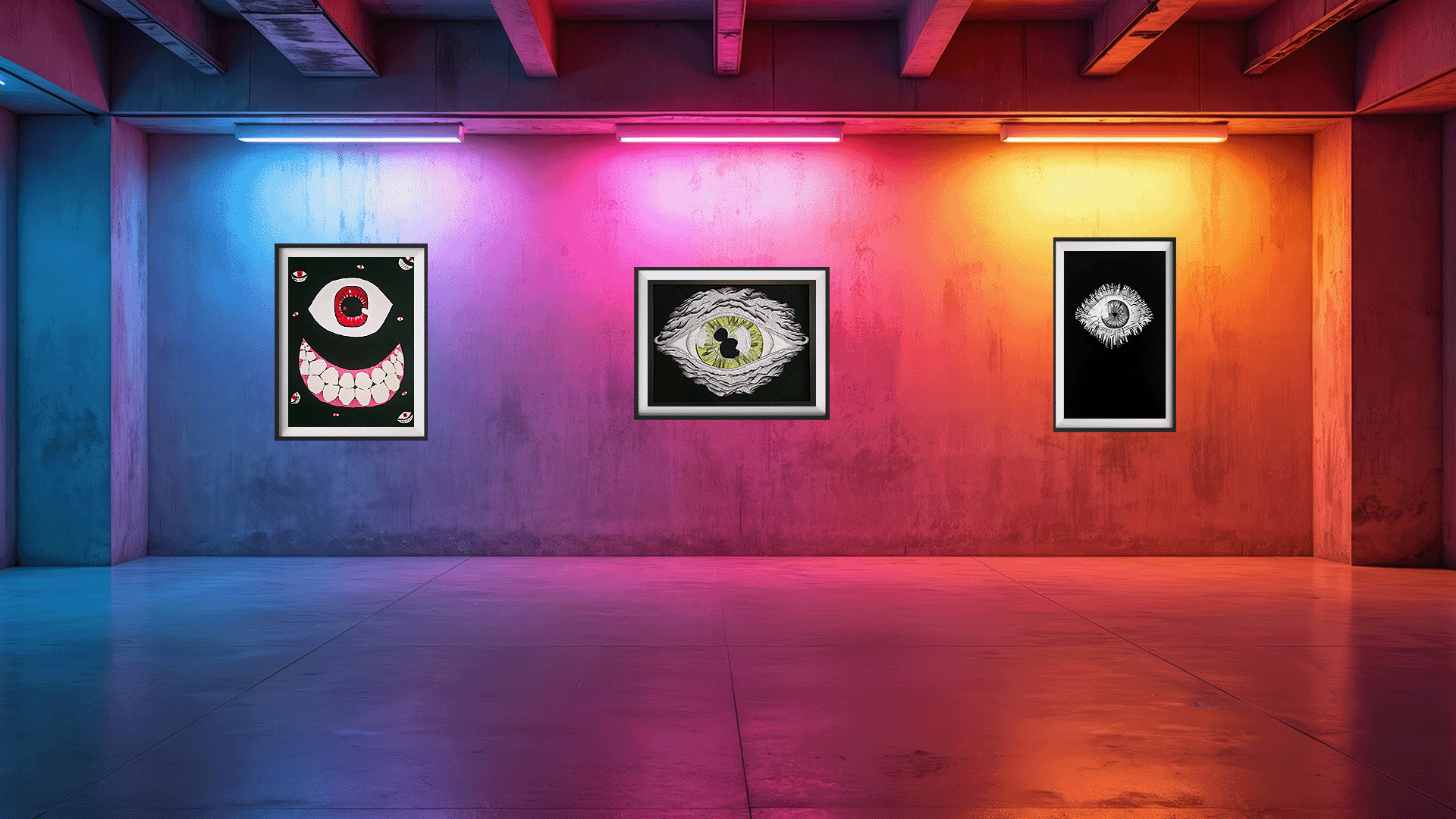

Observation influences behavior in ways people rarely notice at first, but ever so slowly, our minds become aware that something else is watching. Our state of constant surveillance has settled in the background of daily life. Public and private spaces have been filled with cameras, digital tracking, and unseen systems recording activity. Surveillance culture wants us to forget that we’re being watched. It encourages us to ignore that uneasy feeling deep within. Artists engaging with surveillance culture through themes of observation, work to draw out that unsettling feeling. Pushing us to confront that which we’d rather forget.
Artists frequently respond to cultural tension through visual language, which is why themes of observation have recurred across painting, photography, and installation work. Creative works often capture our emotional responses to surveillance culture.
Many painters prefer symbolic imagery because symbols communicate emotional weight quickly while leaving room for interpretation. Eyes often appear in this type of work, since the human mind instinctively reacts to a gaze directed outward in an image. A viewer standing before such artwork begins to feel watched, even though the painting remains still. This reversal between observer and subject creates a moment of reflection that sits at the center of many works connected with surveillance in contemporary art.
Artists exploring observation invert the roles of viewer and artwork, introducing a tension that is difficult to ignore. Viewers are not simply studying a canvas filled with staring eyes or confronting expressions; they are instead forced to reckon with that uneasy feeling of being watched. They leave the galleries wondering what else is watching them.
Surveillance and Human Awareness
Human beings react instinctively to the presence of a gaze, a phenomenon researchers have examined through behavioral studies over several decades. Even simple illustrations of eyes placed in public environments have influenced behavior in measurable ways. People tend to act with greater awareness when observation appears possible, even when that observation comes from an image rather than a real person.
Artists recognized this psychological response long before academic research explained it. Portrait painters frequently created compositions in which the subject appeared to follow the viewer across a room. Religious imagery also relied heavily on eyes directed outward from sacred figures, encouraging viewers to feel that divine awareness extended beyond the canvas. A single gaze within a portrait could communicate compassion, suspicion, curiosity, or authority. Through careful placement of the eyes, artists directed attention and emotional interpretation. Repetition often amplifies the effect.
These historical examples demonstrate how strongly visual attention affects perception. Within discussions on surveillance in contemporary art, that effect takes on new meaning because observation no longer belongs solely to people within physical space. Cameras, algorithms, and digital systems collect information across countless environments.
Because of that context, artwork exploring observation often carries deeper emotional weight. A painting filled with eyes can suggest technological surveillance even without depicting any machines. Because the viewer brings personal awareness of constant observation into the gallery space, symbolic imagery resonates strongly.
Surveillance in Contemporary Art
Artists across many disciplines examine observation through installations, performance pieces, photography, and painting. Some artists build interactive installations that use cameras to display viewers on nearby screens. Others construct environments in which visitor data influences projected imagery.
However, there is still strength in the continued use of symbolic imagery.
By depicting eyes, artists can express emotional tension while inviting the viewer to draw connections to modern forms of surveillance. This symbolic method allows artists to explore internal experiences linked to observation, highlighting what is hidden behind technology. Though it looks different, a watching eye is still an eye.
This imagery rarely depends on direct representations of cameras or digital systems. Instead, it reflects emotional responses connected with being watched and remaining visible. Through symbolic language, such as exaggerated gazes and expressive faces, visual works can explore the tension of constant observation. In this way, such imagery contributes meaningfully to broader discussions surrounding art and surveillance culture.
Making Its Presence Known
Multiple gazes within a single image create a sensation that attention surrounds the viewer from several directions.
Visual work that explores observation often relies on this strategy to create tension within the image. Eyes may appear repeatedly across the surface, sometimes standing alone and sometimes emerging from distorted expressions or unexpected forms. Through repetition and unusual scale, the gaze spreads across the composition, beginning to feel present in more than one place at the same time.

Because viewers react instinctively to eye contact, imagery built around gaze can create immediate emotional engagement. That engagement often deepens once the viewer begins to notice subtle irregularities around each eye, such as exaggerated proportions or expressions that feel slightly unnatural. The longer someone studies the image, the stronger the sense grows that attention moves outward from the canvas and into the space occupied by the viewer.
Inviting Smile and the Uneasy Gaze
Visual works exploring observation sometimes begin with imagery that feels immediately recognizable. A smiling expression, for example, may appear welcoming at first glance and invite the viewer into the composition. Familiar facial cues often create an initial sense of comfort, encouraging the viewer to look closer and spend more time with the image.
That sense of ease can begin to change once attention lingers on the details. An eye may appear larger than expected, or additional gazes may seem to emerge from surrounding forms. Teeth might stretch slightly beyond natural proportion, turning what once appeared friendly into something more ambiguous. These small distortions introduce tension while still preserving the recognizable shape of a human expression.
Through this kind of imagery, artists explore how observation can hide inside familiar forms. A smile normally suggests warmth and approachability, yet subtle alterations can transform that meaning entirely. The viewer may begin sensing that the expression observes rather than welcomes.
This reaction connects closely with the ideas explored within art and surveillance culture, where attention often appears in ordinary places. The unsettling feeling does not arise from obvious monitoring systems but from the possibility that observation may exist quietly within everyday situations.
The Presence of Observation
This work centers on a single gaze that dominates the composition. A large eye may appear surrounded by layered textures or organic forms that seem to hold it in place. The surrounding surface can resemble skin, folds, or abstract structures, creating the impression that the gaze emerges from something larger hidden beneath the image.

A viewer studying such imagery may begin wondering about the identity behind that gaze. The eye appears directed outward, yet the presence observing the viewer remains undefined. This uncertainty becomes an important part of the experience because the source of attention never fully reveals itself.
Observation often occurs in similar ways within daily life. Cameras record activity without showing the people who later review the footage, while digital systems gather information without revealing the analysts interpreting that data. The watcher remains present but rarely visible.
Imagery built around a single outward gaze captures this feeling effectively. The viewer recognizes attention directed toward them, yet the origin of that attention stays hidden. This tension connects closely with ideas explored in surveillance in contemporary art, where artists investigate how unseen observation influences awareness and perception.
The Viewer’s Awareness and the Returning Gaze
Artists also use surreal imagery that appears almost human at first glance. A single eye may sit near the center of the composition, surrounded by radiating lines, textures, or fragmented forms that extend outward across the surface. These surrounding elements can create the impression that the gaze exists within a wider field of attention.

A viewer encountering this kind of imagery may initially interpret the eye as part of a symbolic figure or expressive form. However, the longer attention remains on the image, the more the gaze appears directed outward beyond the canvas.
That outward attention introduces an unusual interaction between viewer and artwork. The person studying the image begins to sense that the gaze within the composition focuses directly on them. In that moment, the viewer becomes part of the visual experience rather than remaining separate from it.
This interaction reflects a central idea connected with art and surveillance culture. Observation rarely moves in a single direction. Once viewers notice the gaze within an image, awareness begins to turn back toward itself, and the act of looking becomes shared between the artwork and the audience.
Surveillance Culture and Daily Awareness
The ideas connected with observation often extend beyond individual artworks and reflect broader conversations surrounding art and surveillance culture. Observation no longer appears limited to portraits or images where a subject returns the viewer’s gaze. Instead, awareness of being watched now exists within everyday environments, often remaining unnoticed until attention turns directly toward it.
People move through cities filled with cameras placed on buildings, street corners, transit stations, and storefront entrances. Digital environments add another layer to this experience through systems that track browsing activity, purchases, and online interactions. These networks collect vast amounts of information about human behavior, often operating quietly in the background of daily life.
Artists responding to these developments frequently translate that awareness into visual language. Instead of presenting surveillance technology through diagrams or technical explanations, many works focus on the emotional atmosphere created by constant visibility. In discussions of surveillance in contemporary art, the psychological response to observation often becomes the central focus.
Imagery exploring this theme may rely on exaggerated eyes, distorted expressions, or gazes that appear to meet the viewer beyond the canvas. These elements create the impression that attention exists within the image itself. Through this visual strategy, observation becomes less about machines recording activity and more about the sensation that awareness surrounds the viewer.
This change transforms observation from a technical subject into a perpetual encounter.
The Viewer as Part of the Artwork
One interesting effect within works connected to art and surveillance culture involves the relationship between the viewer and the image. Traditional painting usually presents a scene in which viewers observe figures or objects within the composition. The direction of attention travels from the viewer toward the artwork.
Paintings exploring surveillance reverse that direction of attention. A gaze inside the painting appears directed outward toward the viewer. That subtle inversion alters the experience of standing in front of the canvas.
Instead of observing passively, viewers begin to feel observed. This sensation often develops gradually as viewers notice details that suggest awareness within the image. A single eye might appear directed outward, or several eyes may repeat across the surface of the painting.
Visual works exploring observation often rely on this interaction between gaze and viewer awareness. Exaggerated eyes, repeated gazes, or expressive facial forms can create the impression that attention flows outward from the image itself. As viewers spend more time studying these visual details, they may begin sensing that the artwork recognizes their presence.
This growing awareness changes the experience of viewing. The image remains still, yet the internal exchange between viewer and artwork continues to unfold. What first appears to be a passive act of observation gradually becomes more active, with attention moving back and forth between the image and the person standing before it.
Final Thoughts
The relationship between art and observation continues to generate powerful visual exploration across many creative disciplines. In discussions of art and surveillance culture, artists frequently focus on emotional responses to visibility rather than on technical descriptions of surveillance systems.
The “Under Surveillance” gallery on Art in C Minor illustrates this approach through striking symbolic imagery. Eyes recur throughout the paintings, confronting viewers with gazes that feel both familiar and unsettling.
Through this imagery, the artwork invites reflection on how observation influences awareness, identity, and perception. The paintings do not require technology to communicate these ideas. Instead, they rely on expressive forms that can capture emotional tension directly.
Within the broader conversation surrounding surveillance in contemporary art, symbolic imagery, such as the symbolism of eyes, continues to play an important part in visual storytelling. Artists use these symbols to explore questions about visibility, awareness, and control.
As viewers encounter works like those presented in the “Under Surveillance” gallery, they may find themselves considering a simple yet powerful question.
If observation influences behavior so strongly, what happens once the artwork appears to observe the viewer in return?